Kinematic Ontology: A Euclidean Embedding Framework with Geometric Exclusions¶
J. Thrussell Version 1.0 — June 2026. DOI: 10.5281/zenodo.20669680
Abstract¶
We examine a single postulate: the observable universe is a 3-dimensional hypersurface (3-brane) embedded in flat Euclidean four-space E⁴, advancing unidirectionally in the fourth spatial coordinate w₄, with mass-energy coupling to that advance; what brane-confined observers experience as time is the advance itself, with t ≡ w₄/c a definitional identity rather than a dynamical claim. The framework recovers the kinematic sector of special relativity exactly, gives gravitational time dilation, horizon thermodynamics, and the Lorentzian signature a common geometric origin, and grounds the arrow of time in the positive averaged-energy condition. Its distinguishing feature, however, is that it forbids things that standard cosmology permits: open spatial sections (k < 0) cannot embed even locally; compact flat topologies are excluded at C² smoothness; and cosmic voids must be mass-compensated. These exclusions are derived from classical embedding theorems (Cartan; Beez–Cartan rigidity with the Thomas–Weise determinant condition; the elliptic-point theorem) and constitute falsifiable excess content beyond reinterpretation. We state the framework's scope boundary explicitly, record its negative results, and defer its cosmological applications to a companion paper.
1. Introduction and postulate¶
General relativity, special relativity, and quantum field theory are among the most precisely confirmed structures in physics, and nothing in this paper modifies any equation of any of them. The question pursued here is different: is there an ontological reading of the existing, empirically successful mathematics under which a cluster of long-standing conceptual puzzles — the origin of the Lorentzian signature, the arrow of time, the invariance of c, the null character of photon worldlines, the effectiveness of the Euclidean path-integral programme, the universal 2π in horizon thermodynamics — acquire a common home? And, more sharply: does any such reading carry consequences of its own, statements that are not shared with the standard picture and that observation could refute?
Postulate. The universe is a 3-hypersurface embedded in flat Euclidean four-space E⁴. The hypersurface advances unidirectionally in the fourth spatial coordinate w₄. Mass-energy couples to the advance; massless degrees of freedom do not. What brane-confined observers experience as time is the advance itself.
Two clarifications belong with the statement of the postulate.
First, the temporal identification is definitional, not dynamical. We set t ≡ w₄/c: time is w₄ displacement expressed in conventional units. The framework therefore never asserts that the brane advances "at speed c through w₄" — a statement that would be circular, since speed presupposes time. All physical content is carried by ratios of displacements: the ratio of a clock's w₄ displacement to a reference displacement, the ratio of brane-tangential to w₄ displacement for a moving body. Where the word "rate" appears below it abbreviates such a ratio. We use advance throughout for the brane's w₄ evolution.
Second, the paper's claim structure should be stated at the outset. The framework is, in large part, an interpretive reading: it recovers standard results under a different ontology. But it is not only that. Because the postulate demands that the spatial geometry of the universe be realisable as an actual hypersurface of E⁴, it inherits the full rigidity of classical embedding theory — and embedding theory forbids things. Section 2 derives three exclusions that standard cosmology does not make; they constitute the framework's falsifiable excess content.
The postulate makes no claim about why the universe has this structure; that remains primitive. It introduces no new fields, particles, or forces, and — with the exclusions of Section 2 as the explicit exception — no new empirical content in regimes where GR, SR, and QFT are already successful.
2. What the postulate forbids¶
The postulate's strongest consequences come from a fact that has no analogue in standard cosmology: not every Riemannian 3-geometry is realisable as a hypersurface of E⁴. General relativity constrains the intrinsic geometry of spatial sections and is indifferent to whether they embed in anything; the postulate adds the embedding as a physical requirement, and the classical rigidity theory of hypersurfaces then does the rest.
2.1 The algebraic Gauss criterion¶
For a hypersurface of E⁴ the Gauss equation expresses the intrinsic curvature entirely through the second fundamental form K: R_{ijkl} = K_{ik}K_{jl} − K_{il}K_{jk}. In three dimensions the Riemann tensor is equivalent to the symmetric curvature operator M (the matrix of sectional curvatures in an orthonormal frame), and the Gauss equation becomes an algebraic statement: M must equal the cofactor matrix of K. Solvability is then a determinant condition:
Necessary local condition for a C² hypersurface in E⁴: det M ≥ 0. When det M > 0, the second fundamental form is recovered algebraically and uniquely up to overall sign, K = ±cof(M)/√(det M).
The attribution of these results requires some care. The rigidity statement — type number ≥ 3 implies the second fundamental form is determined up to sign — is the Beez–Cartan theorem. The codimension-one solvability condition det M ≥ 0, with uniqueness up to sign when strict, is due to Thomas (1936) and Weise; for the general local isometric embedding problem and refinements of these conditions see Jacobowitz (1982). The criterion is local, algebraic, and computable in one line for any candidate cosmology, which is the source of the framework's empirical leverage.
2.2 The ladder of FLRW geometries¶
Applying the criterion to the three FLRW spatial geometries and to the canonical strong-field test case:
| Geometry | det M | Verdict |
|---|---|---|
| S³ (closed, k > 0) | +1/a⁶ | embeds; K recovered, round-sphere form |
| E³ (flat, k = 0) | 0 | marginal; embeds (trivially, as a flat slice) |
| H³ (open, k < 0) | −1/a⁶ | forbidden |
| Schwarzschild t = const slice | +2m³/r⁹ | embeds; recovered K matches Flamm's paraboloid exactly |
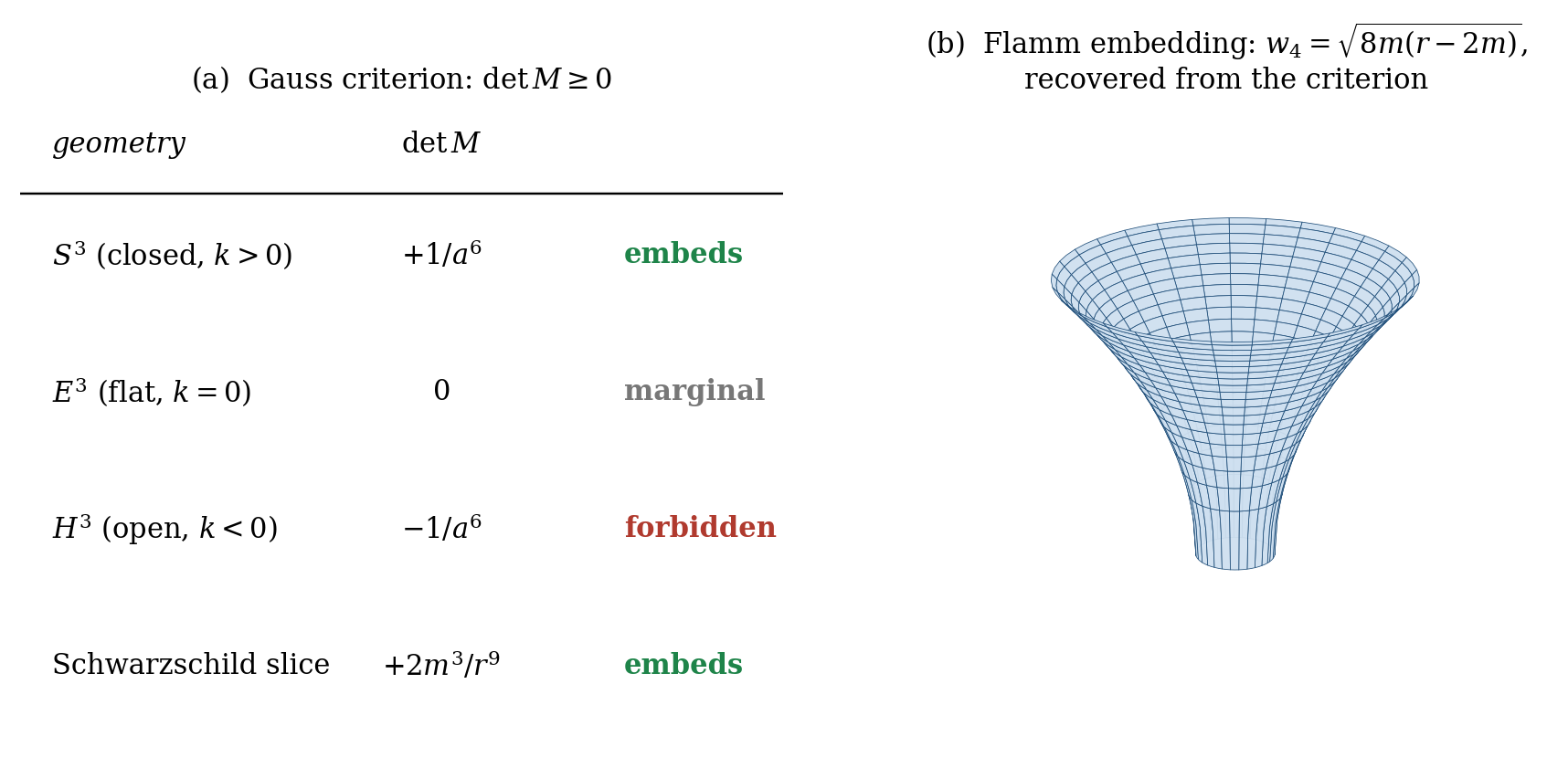 Figure 2. (a) The algebraic Gauss criterion applied to the FLRW
geometries and the Schwarzschild slice. (b) The Flamm embedding,
w₄ = √(8m(r − 2m)), whose principal curvatures are recovered
algebraically from the same criterion that forbids H³ (test 15).
Figure 2. (a) The algebraic Gauss criterion applied to the FLRW
geometries and the Schwarzschild slice. (b) The Flamm embedding,
w₄ = √(8m(r − 2m)), whose principal curvatures are recovered
algebraically from the same criterion that forbids H³ (test 15).
The H³ exclusion is not an artefact of the algebraic shortcut. It is Cartan's theorem (1919–1920): hyperbolic n-space admits no local isometric immersion into E^(2n−2) — for n = 3, no local immersion into E⁴. The obstruction is local: no patch of an open FLRW universe, however small, is realisable as a hypersurface of E⁴. (We state only the E⁴ claim: local immersions of H³ into E⁵ do exist — Cartan also proved that codimension 2n−1 is achievable — so the exclusion is specific to the codimension-one postulate. Otsuki (1954) provides an independent proof of the E^(2n−2) obstruction.)
The Schwarzschild row provides the continuity check between the exclusion machinery and the recovery machinery: the constant-time Schwarzschild slice satisfies det M > 0 outside the mass, and the second fundamental form recovered algebraically from the criterion reproduces the principal curvatures of Flamm's paraboloid exactly (Section 6 returns to this surface). The same theorem that forbids H³ constructs the Schwarzschild embedding.
2.3 Topology: the compact flat case¶
A spatially flat universe passes the local criterion, but the postulate also constrains topology. Every compact C² hypersurface of E^(n+1) possesses an elliptic point — a point where all principal curvatures have the same sign — and a flat compact 3-manifold (a 3-torus) has nowhere any such point. A compact flat universe therefore cannot be a C² hypersurface of E⁴. Tompkins (1939) gives the general statement that no compact flat n-manifold immerses isometrically in E^(2n−1).
One qualification is essential: the obstruction is a C² statement. By the Nash–Kuiper theorem, C¹ isometric embeddings are radically flexible, and the flat 3-torus does embed C¹ in E⁴ — for codimension one this is specifically Kuiper's (1955) extension of Nash's (1954) codimension- two construction. The framework's exclusion therefore reads: a compact flat universe is impossible if the brane is C² smooth. C² is not merely an aesthetic preference here; it is enforced dynamically. The Nash–Kuiper constructions achieve isometry through unbounded oscillation of the embedding at fine scales — the second fundamental form diverges — and any brane action containing a bending-stiffness term (as the framework's minimal action does; Section 7) assigns such configurations divergent energy. Quantitatively, for Kuiper-style corrugation sequences the isometric work is frequency-independent while the bending energy grows as the square of the corrugation frequency, without bound over the staged construction (test 26). A C¹-but-not-C² brane is therefore not a smooth universe that happens to evade a theorem; it is an infinite-energy configuration, excluded by the same dynamics that regulate the brane elsewhere. The H³ obstruction of §2.2 requires no such argument, being curvature-based at any smoothness for which curvature is defined.
2.4 Perturbed slices and compensation¶
The realistic universe is not exactly FLRW. At linear order, writing the perturbed flat slice's curvature operator in terms of the metric perturbation ψ gives M = Hess(ψ) − (∇²ψ)I, which is odd in ψ: overdense regions satisfy det M > 0 and embed; isolated underdense regions — uncompensated voids — drive det M < 0 and are forbidden by the same criterion that excludes H³. The resolution is not exotic: a void whose missing mass resides in its surrounding walls and filaments (mass-compensated, in the standard sense) presents no net negative-mass far field and admits an embeddable configuration. The criterion is to be read at the appropriate scale: it applies to the coarse-grained curvature operator of the slice, so small-scale or transient underdensities — already compensated within their local environment — do not trigger the exclusion; the scale-separation bookkeeping that licenses this statement (the corrugation contribution entering only at quadratic order, with the analysis scale dropping out) is established in the ancillary homogenisation lemma (test 21). The coarse-grained reading is verified directly in test 27: the negative-determinant measure of an uncompensated toy void follows the scale-free law of a coherent point deficit — its exterior field takes the negative-mass Schwarzschild form 2m³/r⁹ with m < 0, so the violation is present with calculable magnitude at every analysis scale — while that of an identically shaped but shell-compensated void collapses super-power-law once the smoothing scale exceeds the compensation radius. The existence of an embeddable physical leaf for realistic perturbed cosmologies, including the void sector, is established in the companion work; here we state the result and its derivation is not reproduced [companion paper / programme note, in preparation].
2.5 Summary of exclusions¶
E1. k ≥ 0. Open FLRW universes are forbidden, locally and hence globally. Observational status: consistent — Planck and BAO constrain Ω_k to zero within ~10⁻³, with the CMB alone mildly preferring closure. A future robust detection of k < 0 falsifies the framework outright.
E2. No compact flat topology (C²). Observational status: consistent — CMB matched-circle and correlation searches find no topology signal within the horizon. A confirmed 3-torus detection falsifies the C² framework.
E3. Voids must be mass-compensated. Observational status: consistent — realistic voids in ΛCDM simulations and survey data are compensated structures. A confirmed large, uncompensated void falsifies the framework.
No parameter of the framework was tuned to produce E1–E3; they follow from the postulate together with classical theorems.
3. Kinematic recovery and shared ground¶
We now exhibit the recovery sector, beginning with what is owed to prior work.
3.1 The Euclidean 4-speed constraint and the dilation sector¶
Every infinitesimal brane element satisfies the Euclidean constraint
|v|² + u² = c², (1)
where v is 3-velocity on the brane and u ≡ c·(dw₄ element ratio) is the advance component; in displacement language, brane-tangential and w₄ displacements compose by the Euclidean Pythagorean identity with fixed total. Massless degrees of freedom have u = 0 and hence |v| = c always; massive ones have u > 0 and |v| < c regardless of energy invested in tangential motion. Solving (1),
u = c√(1 − v²/c²), (2)
and identifying the local advance ratio with clock rate yields the exact Lorentz factor γ = c/u and the standard dilation dτ = dt/γ (Figure 1).
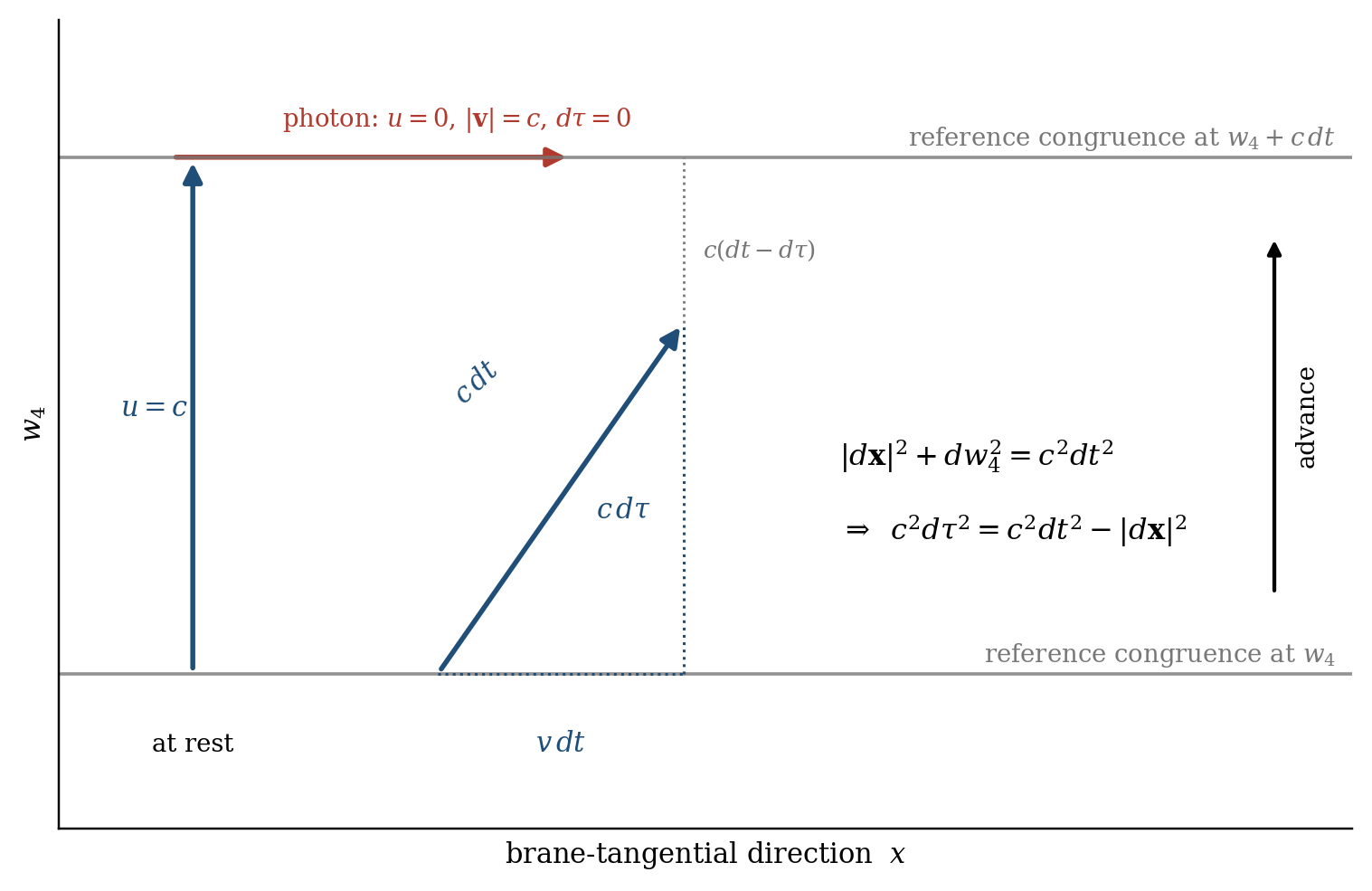 Figure 1. The Euclidean displacement budget. Per reference advance
c dt, a body at rest advances fully in w₄; a moving body splits the
budget between tangential displacement v dt and advance c dτ, with the
Lorentzian interval arising as the Pythagorean residual (Section 4). A
photon carries no advance and is confined to the surface. Measured
against constant-w₄ surfaces, the velocity a brane observer attributes to
a moving body is the SR proper velocity γv = c·sinh η, and these
compose additively in rapidity η, matching SR exactly. What the
construction naturally delivers is therefore the dilation/proper-velocity
sector of SR; the full Lorentz group acting on fields is not derived
here and is recorded as an open problem in Section 8.
Figure 1. The Euclidean displacement budget. Per reference advance
c dt, a body at rest advances fully in w₄; a moving body splits the
budget between tangential displacement v dt and advance c dτ, with the
Lorentzian interval arising as the Pythagorean residual (Section 4). A
photon carries no advance and is confined to the surface. Measured
against constant-w₄ surfaces, the velocity a brane observer attributes to
a moving body is the SR proper velocity γv = c·sinh η, and these
compose additively in rapidity η, matching SR exactly. What the
construction naturally delivers is therefore the dilation/proper-velocity
sector of SR; the full Lorentz group acting on fields is not derived
here and is recorded as an open problem in Section 8.
Gravitational time dilation enters by the identification u(x) = u₀√(−g_tt(x)) in any static solution: the framework does not choose u(x) but reads it off whatever g_tt Einstein's equations provide. Deeper potential, smaller advance ratio, slower clocks — the textbook result, given a geometric reading. Photon worldlines carry no internal advance (u = 0), hence no proper time: the SR null condition acquires a mechanism (no rest mass → no w₄ coupling → no internal clock), and photons are confined to the surface, a fact Sections 5 and 6 both use.
3.2 Relation to the Euclidean Relativity programme¶
The kinematic skeleton above — Euclidean 4-speed, Lorentz factor from Pythagoras, proper-velocity composition — is not original to this work. It is the core of the Euclidean Relativity programme: Montanus (1991; 2001, Found. Phys. 31, 1357–1400), Almeida (2001), van Linden (2007), and, most extensively in recent years, Niemz (preprints.org, multiple versions; non-peer-reviewed). We claim no priority on any of it; Sections 1–3.1 are a synthesis of that lineage. The present paper's contributions are located in Sections 2 and 4–7: the exclusion ladder, the signature/reconstruction interface, the energy-condition grounding of the arrow, the horizon unification read ontologically, and the foliation reading of Λ.
One point of differentiation within that lineage concerns simultaneity. The ER literature is internally divided on simultaneity and the preferred frame (Montanus argues for a preferred simultaneity; Niemz against). The present framework requires neither position as a primitive: its operative foliation is the one defined by the matter congruence of standard cosmology — cosmic time as proper time along the comoving congruence, a symmetry-enabled gauge choice in FLRW (Weinberg 2008; Malik & Wands 2009) — and inherits exactly the status that choice has in mainstream cosmology, no more.
4. Signature derived from the kinematics; Wick and reconstruction as the interface¶
4.1 The Lorentzian interval is the constraint solved for the hidden coordinate¶
The Lorentzian signature of observed spacetime is not assumed in this framework, and it is not imported through Wick rotation. It is derived, in two lines, from the Euclidean constraint of Section 3.
A brane observer has operational access to spatial displacements dx (rulers, light ranging) and to reference time dt (their own clock, with t ≡ w₄/c definitionally), but not to the w₄ displacement of other systems. The Euclidean budget for any element is
|dx|² + dw₄² = c²dt²,
and the element's own advance is its proper time, dw₄ = c dτ. Solving the constraint for the inaccessible quantity:
c²dτ² = c²dt² − |dx|².
This is the Minkowski interval. The minus signs are Pythagorean subtraction: the invariant a brane observer attributes to a worldline — that worldline's own advance — is the residual of the Euclidean budget after spatial motion. The quadratic form on the accessible variables (dt, dx) whose value equals this invariant has one positive and three negative eigenvalues; cross terms dt·dx_i are forbidden by spatial isotropy (the constraint contains dx only through its square). The signature (−,+,+,+) is therefore forced by the kinematics. Its invariance is geometric rather than postulated: dτ measures a real ambient E⁴ length (the element's w₄ displacement), identical under every on-brane accounting of the same segment. The light cone falls out as the zero-advance locus (dτ = 0 ⟺ |dx| = c dt), consistent with the surface confinement of photons, and dτ/dt = √(1 − v²/c²) recovers γ — closing the loop with Section 3. These statements are verified symbolically in the test suite (test 25).
The scope of this derivation is as follows: it delivers the metric and interval structure — the signature as it appears in kinematics. The action of the full Lorentz group on fields is not derived here and remains the framework's principal open formal problem (Section 8).
4.2 Wick rotation and Osterwalder–Schrader as supporting structure¶
With the signature derived kinematically, the role of the Euclidean–Lorentzian interface machinery can be stated precisely: it is the evidence that the derivation extends consistently to the field-theoretic level. Wick rotation, conventionally a computational device, acquires under this reading an ontological status — the dictionary between the real Euclidean embedding and the effective Lorentzian encoding, an interface rather than a process. The framework here aligns with, and goes one step beyond, the Euclidean quantum-gravity programme (Gibbons & Hawking 1977; Hartle & Hawking 1983), which treats the Euclidean formulation as near-physical and rotates back at the end; we read the Euclidean side as primary.
The rigorous backbone is the Osterwalder–Schrader reconstruction (Osterwalder & Schrader 1973; 1975): Euclidean Green's functions satisfying Euclidean covariance, symmetry, regularity, and — centrally — reflection positivity continue analytically to the Wightman functions of a relativistic QFT with a positive-definite Hilbert space and a self-adjoint Hamiltonian generating unitary Lorentzian evolution. We note one technical point: the 1973 paper's claim that axioms (E0)–(E4) alone suffice contained a flaw, corrected in the 1975 paper by the addition of the linear-growth condition (E0′); the analytic continuation itself already follows from temperedness, covariance, and reflection positivity, with (E0′) controlling the reconstruction estimates. We cite both papers and rely on nothing stronger than the corrected theorem.
The conceptual fit we register, at the level of structural resonance and no stronger: reflection positivity — positivity of a quadratic form under reflection in Euclidean time — is the axiom that makes a Euclidean theory secretly Lorentzian, and a positivity condition on energy is precisely what the framework's arrow mechanism (Section 5) takes as physical input. We do not claim the framework derives the OS axioms. We also note, to avoid a possible conflation, that the Euclidean Relativity literature of Section 3.2 is distinct from the Wick/OS machinery and supplies none of its rigour; the load-bearing mathematics of this section is Osterwalder–Schrader.
5. The arrow of time¶
In this framework the arrow of time is selected rather than postulated, and selected by an independently supported physical condition.
5.1 Orientation is conventional; the asymmetry is universality¶
E⁴ has a w₄ → −w₄ reflection symmetry, and the framework's equations admit advance in either orientation; nothing in the geometry prefers "positive" w₄. The physical content of the arrow therefore cannot reside in a choice of orientation, and the claim made here is orientation-free. The physical content of the arrow is twofold: (i) universality — all stable mass-energy occupies a single advance branch, whichever label it carries; and (ii) no switching — no stable matter migrates to the opposite branch. A universe spontaneously occupies one branch (the selection is symmetry breaking, not dynamics; the mirror universe is equally consistent and empirically indistinguishable from inside), and the positivity of energy is what locks the branch rather than what chooses it.
The locking works as follows. Matter coupled to the advance with the opposite sign relative to the occupied branch would constitute, on the brane, stable negative mass-energy. The classical pointwise energy conditions are violable locally by quantum effects (Casimir configurations, squeezed states, Hawking radiation), but the averaged conditions — ANEC and its relatives — remain robust in semiclassical QFT and exclude stable macroscopic negative energy (Graham & Olum 2007, and the wormhole/CTC exclusion literature: Morris & Thorne 1988; Hawking 1992; Visser 1996). The framework reads this exclusion geometrically: branch switching is stable negative energy, and is excluded with it. What survives of counter-advance is exactly the transient, paired, locally-compensated kind that quantum field theory already contains — Section 5.3.
The logical chain, exhibited for inspection: spontaneous branch occupation (convention-fixing, no physics) → positive averaged/bulk energy condition → no stable opposite-branch matter → unidirectional advance of everything → observer-internal arrow. The chain has been tested for circularity (does any link presuppose a temporal asymmetry?) and carries none: the energy condition is a statement about field configurations, not about time direction, and the only orientation-dependent step is an explicit convention.
5.2 Counter-advancing trajectories are measure-zero events¶
A worldline element directed against the advance does not inhabit the brane's history; it intersects the advancing hypersurface in isolated point events. Persistent counter-advance would require persistent negative coupling — excluded above. What survives of counter-advance is exactly what quantum field theory already contains, which brings us to the rehoming.
5.3 Feynman–Stückelberg, rehomed¶
In the Feynman–Stückelberg picture, antiparticles are particles traversing time in reverse — a formal reading that the standard interpretation keeps at arm's length. The framework gives it a literal geometric home: a hairpin worldline in E⁴, doubling back against the advance, intersects the advancing brane twice while the hairpin is ahead of the surface and then not at all. On-brane observers register: pair creation (two intersections appear), coexistence, annihilation (intersections merge and vanish); see Figure 3. Both observed branches carry positive brane-side energy, exactly as both members of a real pair do; the "negative" character of the reversed segment never appears on the brane as negative energy, only as opposite charge — consistent with CPT, which the framework's scope tests confirm it respects. Pair production, an awkward guest in a single-time ontology, is a native resident of an advancing-brane one.
5.4 A passed test¶
The mechanism requires that antimatter couple to gravity exactly as matter does (both branches are positive-energy brane residents in the same dimple). The ALPHA-g measurement of antihydrogen free fall (Anderson et al., Nature 2023) found antimatter falls down, with gravitational acceleration consistent with g. The framework passed a test it could have failed.
5.5 Relation to other geometric arrows¶
Barbour, Koslowski & Mercati (2014) derive an arrow from a minimum-complexity Janus point; Boyle, Finn & Turok (2018) from a CPT-symmetric universe pair; Niemz grounds it kinematically in monotone covered distance. All are distinct from the present mechanism. The grounding of the arrow in the positive averaged-energy condition acting on the coupling, with the general-relativistic association to negative-energy structures, is to our knowledge not present in the prior literature.
6. Thermal horizons from one geometric condition¶
The framework unifies Hawking, Unruh, and de Sitter temperatures by a single mechanism: smoothness of the brane's embedding in the real ambient coordinate.
Near the Schwarzschild horizon, the substitution r = R_s + ρ²/(4R_s) brings the Euclidean section to
ds²_E ≈ dρ² + ρ²·(c dτ/2R_s)² + R_s² dΩ²,
a cone unless cτ/(2R_s) has period 2π. Standardly this regularity is a prescription applied to an analytically continued time. In the framework, w₄ is a real ambient coordinate and the demand is plainly geometric: the embedded near-horizon region must be a smooth submanifold of E⁴, free of conical defect. The period 4πR_s/c is a real period; brane fields probing the region encounter it directly and acquire thermal character at
T_H = ħc³ / (8πGMk_B),
the exact Hawking temperature (61.7 nK for a solar mass; recovered to machine precision in the ancillary test suite). The same smoothness demand applied to the Rindler wedge yields the Unruh temperature T = ħa/(2πck_B), and applied to the de Sitter horizon yields the Gibbons–Hawking T = ħH/(2πk_B); the ¼ prefactor of the area law follows on the same machinery. A parallel unification of these temperatures is achieved by the GEMS programme (Deser & Levin 1998–1999, and successors) via higher-dimensional Lorentzian embeddings. The present construction differs in requiring one geometric condition on a real four-dimensional Euclidean ambient, with no auxiliary higher-dimensional Minkowski space, and in reading the periodicity as a property of the world rather than of an analytic continuation. The continuity with Section 2 is exact: the surface whose smooth embedding is being demanded here is the same Flamm geometry the rigidity criterion constructed there.
7. Λ as foliation cost: form, sign, and channel separation¶
The cosmological constant problem, as conventionally stated, is the 10¹²⁰ mismatch between the QFT vacuum-energy estimate and the observed Λ. The framework treats the identification of these two quantities as a category error, and exhibits the distinction at the level of an action.
The minimal brane action consistent with the postulate (a tension term, a stiffness term, and a matter coupling; developed and tested in the programme's companion work) contains the demonstration in its structure. On the homogeneous background — the uniform advance w = ct, no matter, no curvature — the Lagrangian density reduces to a field-independent, gradient-free constant:
L_background = σc²/2 ≡ Λ_f,
a pure volume term in the action. That is the form of a cosmological constant, arising from the advance itself: the foliation cost named. Three structural results follow without computing any magnitude.
Form. Λ enters the action as the coefficient of the volume — a genuine dynamical term of the embedding, not a relabelling of vacuum energy.
Sign. Λ_f = σc²/2 is positive if and only if the brane density σ is positive — the same positivity that locks the arrow branch in Section 5. A positive cosmological constant is thereby derived rather than fitted.
Channel separation. In the same action, matter and field energy — including the vacuum energy of brane fields — enters exclusively through the coupling term λρw, which sources inhomogeneities: dimples in the brane, the w ∝ Φ equilibrium of the ancillary tests. The foliation cost enters exclusively through the background kinetic term: homogeneous, sourcing nothing. Vacuum energy and Λ thus flow through different functional channels of the same action. The conventional identification of the two — gravitating vacuum energy as the source of Λ — is thereby shown to be, within this framework, a category error exhibited rather than asserted: the QFT estimate was never an estimate of Λ_f; it estimates a ρ-channel quantity that dimples the brane like any other energy. There is then no 120-order discrepancy to explain, because no identification was made. (These three statements are verified symbolically in test 25.)
Two boundaries remain. The magnitude of Λ is not predicted: it requires fixing σ, the framework's one open action coefficient, and this remains an explicit open obligation of the programme. And the dissolution carries an obligation: a full accounting of the ρ-channel gravitation of brane vacuum energy must show that it does not reintroduce the problem through the back door. The de Sitter consistency loop, meanwhile, closes within the framework's own machinery: uniform advance manifests on-brane as baseline expansion, whose horizon temperature is the Gibbons–Hawking T = H/2π recovered in Section 6 — the foliation reading and the thermal reading meet.
8. Scope, exclusions, and predictions¶
8.1 The scope boundary¶
The framework natively homes the g_tt/kinematic sector: dilation, advance, horizon thermality, signature, arrow. Everything outside that sector — the full Einstein field equations, the Lorentz group action on fields, gauge structure, particle content — is inherited from standard physics unchanged. The boundary coincides, in the ancillary tests, with the textbook gravitoelectromagnetic decomposition: PPN γ, lensing's canonical half-and-half split, frame-dragging, TOV structure, and Kerr–Newman thermodynamics are all recovered because they were never modified. The division of labour between the inherited and the native sectors is as follows. The framework does not derive the Einstein field equations and does not claim to; metric dynamics are GR's own, unmodified. What the framework's action governs is the embedding: the brane's shape response to the matter GR describes — whose static equilibrium tracks the Newtonian potential exactly (w ∝ Φ in the ancillary tests; test 22) — while the advance-rate identification u = u₀√(−g_tt) is read off whatever solution Einstein's equations supply. GR computes the metric; the embedding realises it; neither does the other's job. Whether the field equations themselves admit a variational origin at the embedding level is an open question the programme records without prejudging.
The principal open formal problem — the action of the full Lorentz group on fields — can now be stated as a well-posed target rather than a lacuna. By the Osterwalder–Schrader reconstruction (Section 4.2), a Euclidean field theory whose correlation functions satisfy the OS axioms — reflection positivity centrally among them — is a Lorentz-covariant quantum field theory; covariance comes with the reconstruction. The open problem is therefore precise: show that field theories supported on the advancing brane satisfy the OS axioms, with reflection positivity expected to enter through the same positivity structure that locks the arrow branch and fixes the sign of Λ_f. We do not claim this result; we claim it is the well-defined mathematical question whose answer would complete the recovery, which is what makes the gap tractable rather than foundational.
Where the framework reproduces a standard result, the correspondence is exact by construction; the postulate's empirical content lies in the Section 2 exclusions, not in modified predictions within tested regimes.
8.2 Negative results¶
For completeness we record the programme's negative results. Within the dark-matter question alone: extrinsic-curvature contributions outside a central mass vanish identically (Gauss–Codazzi); kinematic shear backreaction has the wrong magnitude; the corrugation field cannot depress g_tt kinematically for slow matter (the effect is v²/c²-suppressed); and elastic corrugation energy is structurally capped near the dark-energy density and cannot form halos. The framework is, at this writing, agnostic on dark matter with recorded exclusions — it neither contains nor requires a candidate, and four candidate mechanisms internal to the programme have been tested and tested against pre-stated exclusion criteria and excluded.
8.3 Predictions¶
The falsifiable content of this paper is E1–E3 of Section 2.5: k ≥ 0; no compact flat topology at C²; mass-compensated voids. Each is a standing exposure to data that standard cosmology does not share — ΛCDM accommodates k < 0 and toroidal topology without complaint; this framework cannot.
Two further predictions belong to the cosmological layer and are developed, with derivations, in the companion paper; we note them briefly and rely on neither in this paper. The framework's slicing analysis predicts a directional anisotropy in locally inferred H₀ of order several percent, correlated with the large-scale matter distribution; and it requires consistency between the CMB kinematic dipole and the matter dipole of the kind probed by quasar-catalogue measurements.
8.4 On the question of redundancy¶
It may be asked whether the E⁴ embedding is merely a reinterpretation — observationally idle by construction. Section 2 is the answer: an interpretation with no excess content could forbid nothing, and this one forbids three things, each observationally live. The exclusions are not ornaments on the reading; they follow from the same postulate that does the reinterpreting, by way of classical theorems. A future detection of spatial hyperbolicity, of a compact flat topology, or of a large uncompensated void would refute the framework. No statement of that kind is available to a pure reinterpretation.
9. Relation to prior art¶
The kinematic core is the Euclidean Relativity lineage (Montanus 1991, 2001; Almeida 2001; van Linden 2007; Niemz, non-peer-reviewed preprints), conceded in full in Section 3.2; this paper is a synthesis and extension of that skeleton, not a rediscovery of it. The embedding-rigidity machinery is classical differential geometry (Cartan; Beez–Cartan; Thomas–Weise; Jacobowitz; Kuiper; Tompkins) imported, we believe for the first time, as a cosmological exclusion principle. The Euclidean–Lorentzian interface rests on Osterwalder–Schrader, which belongs to constructive QFT and not to the ER genre. The horizon unification parallels the GEMS programme in result while differing in ambient structure and ontological commitment. The arrow-of-time mechanism is, to our knowledge, new in its specific grounding; the general project of geometric arrows has distinguished prior claimants (Barbour–Koslowski–Mercati; Boyle–Finn–Turok) from whom we differ as stated in Section 5.5. Novelty is claimed only where a search of the prior literature has found none.
Appendix: reproducibility¶
All quantitative claims in this paper are supported by numbered, self-contained Python test scripts (NumPy/SymPy) archived with the manuscript (OSF/Zenodo DOI on submission): the SR partition (tests 1–6), thermal horizons (Hawking, Unruh, de Sitter, Kerr–Newman suite), the rigidity ladder and Flamm recovery (test 15), void compensation thresholds (tests 16–17), slicing robustness (tests 18–20), the homogenisation lemma (test 21), the minimal-action checks (test 22), and the dark-matter exclusions of §8.2 (tests 23–24), the signature/Λ-structure derivations of §§4 and 7 (test 25), the bending-energy divergence of Kuiper corrugation sequences (test 26), and the coarse-grained determinant criterion for compensated and uncompensated voids (test 27). Each script prints a PASS/FAIL verdict against a stated criterion; none reconstructs a standard result from memory.
The correspondence between the paper's principal claims and the scripts supporting them is as follows.
| Claim (section) | Supporting test(s) |
|---|---|
| SR dilation / proper-velocity sector (§3.1) | 1–3 |
| Lorentzian interval and signature (§4.1) | 25 |
| E1: H³ forbidden; rigidity ladder; Flamm recovery (§2.2) | 15 |
| E2: compact flat excluded; C¹ configurations divergent (§2.3) | 15, 26 |
| E3: void compensation, coarse-grained criterion (§2.4) | 16, 17, 21, 27 |
| Hawking / Unruh / de Sitter temperatures (§6) | 9, and the dedicated horizon suite |
| Kerr–Newman thermodynamics, CPT, PPN γ, lensing, TOV (§8.1) | scope tests 1–12 |
| Λ form, sign, channel separation (§7) | 22, 25 |
| Minimal action: waves at c; w ∝ Φ; no ghosts (§7, §8.1) | 22 |
| Dark-matter exclusions (§8.2) | 23, 24 |
References¶
- Cartan, É. (1919–1920). "Sur les variétés de courbure constante d'un espace euclidien ou non euclidien." Bull. Soc. Math. France 47, 125–160; 48, 132–208.
- Thomas, T. Y. (1936). "Riemann spaces of class one and their characterization." Acta Math. 67, 169–211.
- Nash, J. (1954). "C¹ isometric imbeddings." Ann. Math. 60, 383–396.
- Kuiper, N. H. (1955). "On C¹-isometric imbeddings I, II." Indag. Math. 58, 545–556; 683–689.
- Tompkins, C. (1939). "Isometric embedding of flat manifolds in Euclidean space." Duke Math. J. 5, 58–61.
- Otsuki, T. (1954). "Isometric imbedding of Riemann manifolds in a Riemann manifold." J. Math. Soc. Japan 6, 221–234.
- Jacobowitz, H. (1982). "Local isometric embeddings." In Seminar on Differential Geometry (S.-T. Yau, ed.), Annals of Mathematics Studies 102, 381–393.
- Osterwalder, K. & Schrader, R. (1973). "Axioms for Euclidean Green's functions." Comm. Math. Phys. 31, 83–112.
- Osterwalder, K. & Schrader, R. (1975). "Axioms for Euclidean Green's functions II." Comm. Math. Phys. 42, 281–305.
- Montanus, J. M. C. (2001). "Proper-time formulation of relativistic dynamics." Found. Phys. 31, 1357–1400.
- Almeida, J. B. (2001). "An alternative to Minkowski space-time." arXiv:gr-qc/0104029.
- van Linden, R. (2007). Euclidean relativity (online programme).
- Niemz, M. (2025). Euclidean-relativity preprint series (preprints.org; non-peer-reviewed).
- Gibbons, G. W. & Hawking, S. W. (1977). "Cosmological event horizons, thermodynamics, and particle creation." Phys. Rev. D 15, 2738.
- Hartle, J. B. & Hawking, S. W. (1983). "Wave function of the universe." Phys. Rev. D 28, 2960.
- Deser, S. & Levin, O. (1998; 1999). GEMS embeddings and horizon temperatures. Class. Quantum Grav. 15, L85; Phys. Rev. D 59, 064004.
- Morris, M. & Thorne, K. (1988). Am. J. Phys. 56, 395. Hawking, S. W. (1992). Phys. Rev. D 46, 603. Visser, M. (1996). Lorentzian Wormholes. Graham, N. & Olum, K. (2007). Phys. Rev. D 76, 064001.
- Barbour, J., Koslowski, T. & Mercati, F. (2014). Phys. Rev. Lett. 113, 181101. Boyle, L., Finn, K. & Turok, N. (2018). Phys. Rev. Lett. 121, 251301.
- Anderson, E. K. et al. (ALPHA Collaboration) (2023). "Observation of the effect of gravity on the motion of antimatter." Nature 621, 716–722.
- Weinberg, S. (2008). Cosmology. Malik, K. A. & Wands, D. (2009). Phys. Rep. 475, 1–51.